Height on a passport form, a TV screen size, a running distance, a room plan from another country — sooner or later everyone needs a length conversion. The problem is that the world uses two systems: metric (meters, centimeters, kilometers) and imperial or US customary (inches, feet, yards, miles). This guide gives you the exact numbers, simple formulas and handy shortcuts so you can switch between them with confidence.
The Two Length Systems in a Nutshell
The metric system is built on the meter and powers of ten: 1 kilometer is 1,000 meters, 1 meter is 100 centimeters, and 1 centimeter is 10 millimeters. Moving between metric units is just a matter of shifting the decimal point.
The imperial system grew from older, practical measures: 12 inches make a foot, 3 feet make a yard and 1,760 yards make a mile. It’s still used every day in the United States and partly in the UK.
The bridge between the two is exact by international agreement since 1959: 1 inch = 2.54 centimeters. Every other imperial-to-metric factor follows from that.
Key Length Conversion Factors
| From | To | Multiply by |
|---|---|---|
| Inches | Centimeters | 2.54 (exact) |
| Centimeters | Inches | 0.3937008 |
| Feet | Meters | 0.3048 (exact) |
| Meters | Feet | 3.28084 |
| Yards | Meters | 0.9144 (exact) |
| Miles | Kilometers | 1.609344 (exact) |
| Kilometers | Miles | 0.6213712 |
| Millimeters | Inches | 0.03937008 |
How to Convert Feet to Meters
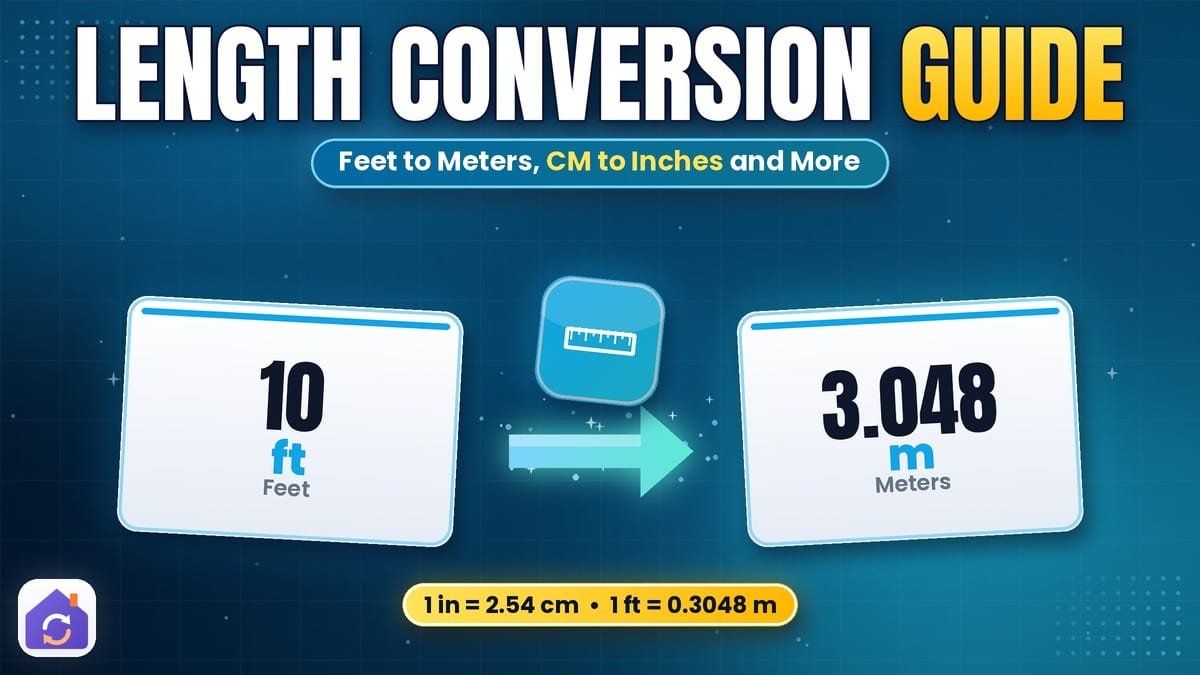
Multiply the number of feet by 0.3048. For example, a 12-foot room is 12 × 0.3048 = 3.66 meters long. To go the other way, multiply meters by 3.28084: a 100-meter sprint is about 328 feet.
A quick mental shortcut: divide feet by 3.3 to get a close estimate in meters. It’s within about 1% — fine for rough planning, not for building work.
How to Convert CM to Inches
Divide centimeters by 2.54, or multiply by 0.3937. A 30 cm ruler is 30 ÷ 2.54 = 11.81 inches. For inches to centimeters, multiply by 2.54: a 55-inch TV has a diagonal of about 139.7 cm.
For many everyday conversions, the dedicated pages are quicker: cm to inches, inches to cm, feet to meters and meters to feet.
Meters to Feet and Inches (for Height)
Height is usually written in feet and inches, not decimal feet. Here’s how to convert 1.75 m:
- Convert to inches: 175 cm ÷ 2.54 = 68.9 inches.
- Divide by 12: 68.9 ÷ 12 = 5 feet with 8.9 inches left over.
- Round: about 5 ft 9 in.
Going the other way, 6 ft 2 in = (6 × 12 + 2) × 2.54 = 188 cm. You can also use cm to feet and feet to cm directly.
Quick Length Conversion Chart
| Metric | Imperial (approx.) |
|---|---|
| 1 cm | 0.39 in |
| 10 cm | 3.94 in |
| 1 m | 3 ft 3.4 in |
| 1.5 m | 4 ft 11 in |
| 1.8 m | 5 ft 10.9 in |
| 5 km | 3.11 miles |
| 10 km | 6.21 miles |
| 42.195 km (marathon) | 26.22 miles |
How to Use the Length Converter
With our free Length Converter:
- Pick the “from” unit (for example feet) and the “to” unit (meters).
- Type a value in either box — the other updates instantly.
- Use the swap button to reverse the direction.
- Choose how many significant digits you want and copy the result.
- Scroll the table to see the same value in every length unit at once.
It covers 92 units, from millimeters and miles to nautical miles, light years, survey feet and historical measures.
Kilometers to Miles for Running and Driving
Multiply kilometers by 0.6214 to get miles, or miles by 1.6093 to get kilometers. A handy approximation: multiply km by 6 and divide by 10 (10 km ≈ 6 miles). Runners know the classics: 5K ≈ 3.1 miles, 10K ≈ 6.2 miles, half marathon ≈ 13.1 miles. See km to miles and miles to km for quick lookups.
Common Length Conversion Mistakes
- Treating 5.5 feet as 5 ft 5 in. 5.5 feet is 5 ft 6 in — decimal feet aren’t inches.
- Rounding too early. Keep extra digits until the final step, especially for construction and engineering.
- Mixing up US survey feet. Old US land surveys use a survey foot that differs from the international foot by about 2 parts per million — tiny, but it matters over long distances.
- Confusing nautical and statute miles. A nautical mile is 1,852 meters, about 15% longer than a regular mile.
Length Conversion in Excel and Word
Excel has a built-in function: =CONVERT(A1,"ft","m") converts feet to meters, and =CONVERT(A1,"cm","in") converts centimeters to inches. In Word, there’s no converter — calculate the values elsewhere and paste them in.
Where Length Conversion Comes Up
- Travel and driving abroad (road signs in km or miles).
- Online shopping for furniture, clothing and screens.
- Medical forms asking for height in cm or feet and inches.
- DIY and construction plans from other countries.
- Science and school homework, which almost always uses metric.
For the history of the meter itself, see the metre article on Wikipedia.
Final Thoughts
Every length conversion comes back to a few exact numbers: 2.54 cm per inch, 0.3048 m per foot and 1.609344 km per mile. Learn those, use the shortcuts for rough estimates, and use a calculator or converter when precision matters. Try the free Length Converter for instant results in 92 units.
Frequently Asked Questions
How do you convert feet to meters?
Multiply the number of feet by 0.3048, which is the exact length of one foot in meters. For example, 10 feet × 0.3048 = 3.048 meters, and a 6-foot person is 6 × 0.3048 = 1.83 meters tall. To go the other way, divide meters by 0.3048 or multiply by 3.28084. Because the factor is exact, you only need to round the final answer, not the factor itself.
How do you convert cm to inches?
Divide the number of centimeters by 2.54, because one inch is exactly 2.54 cm. For example, 50 cm ÷ 2.54 = 19.69 inches, and 170 cm ÷ 2.54 = 66.93 inches. If you prefer multiplying, use 0.3937 instead: 30 cm × 0.3937 = 11.81 inches. For a quick mental estimate, multiply by 4 and divide by 10, which gives a result within about 2%.
How many cm are in an inch?
There are exactly 2.54 centimeters in one inch. This is not a rounded figure: in 1959 the United States, the United Kingdom and other English-speaking countries agreed to define the inch as precisely 25.4 millimeters. That means every inch-to-centimeter conversion is exact, so 12 inches are exactly 30.48 cm and 36 inches are exactly 91.44 cm.
How many feet are in a meter?
One meter is about 3.28084 feet, which is 3 feet and 3.37 inches. This comes from dividing 1 by 0.3048, the exact length of a foot in meters. So 2 meters is about 6.56 feet (6 feet 6.7 inches), and 100 meters is about 328 feet. For rough estimates, multiplying meters by 3.3 is close enough for everyday use, such as room sizes or distances.
How do I convert meters to feet and inches?
First convert the meters to inches by dividing the centimeters by 2.54. Then divide the inches by 12: the whole number is the feet and the remainder is the inches. For example, 1.75 m is 175 cm ÷ 2.54 = 68.9 inches, and 68.9 ÷ 12 = 5 with 8.9 left over, so the answer is 5 feet 8.9 inches. This two-step method avoids the common mistake of reading 5.74 feet as 5 feet 7.4 inches.
What is the formula for length conversion?
Every length conversion is a multiplication: value in new unit = value in old unit × conversion factor. The factor is how many of the new unit fit into one of the old unit, such as 0.3048 for feet to meters, 2.54 for inches to centimeters or 1.609344 for miles to kilometers. To reverse a conversion, divide by the same factor. Keeping track of the units in each step is the easiest way to avoid multiplying when you should divide.
How do I convert cm to inches in Excel?
Use the built-in CONVERT function: =CONVERT(A1,"cm","in"), where A1 holds the value in centimeters. Excel also understands "m", "mm", "ft", "yd", "mi" and "km", so =CONVERT(A1,"ft","m") converts feet to meters. If you prefer a plain formula, =A1/2.54 gives the same result for centimeters to inches. Format the result cell to two decimal places to keep the table readable.
How many miles is 10 km?
Ten kilometers is about 6.21 miles. To get it, multiply kilometers by 0.621371: 10 × 0.621371 = 6.21. This is why a 10K race is often described as a 6.2-mile run. A 5K is about 3.11 miles, a half marathon (21.1 km) is 13.1 miles and a full marathon (42.195 km) is 26.2 miles. To go from miles to kilometers, multiply by 1.609344.
What is 5 feet 7 inches in cm?
Five feet 7 inches is about 170.2 cm. First turn the height into inches: 5 feet × 12 = 60 inches, plus 7 inches gives 67 inches. Then multiply by 2.54: 67 × 2.54 = 170.18 cm. The same two steps work for any height, so 6 feet 0 inches is 72 × 2.54 = 182.88 cm, and 5 feet 2 inches is 62 × 2.54 = 157.48 cm.
Why is the inch exactly 2.54 cm?
Before 1959, the American and British inches differed very slightly, which caused real problems in precision engineering and international trade. That year, the United States, the United Kingdom, Canada, Australia, New Zealand and South Africa agreed on the international yard of exactly 0.9144 meters. Because a yard is 36 inches, one inch became exactly 25.4 mm, or 2.54 cm, and the foot became exactly 0.3048 meters.