Gym weights in pounds, recipes in grams, luggage limits in kilograms, body weight in stone — weight units are everywhere, and they rarely match. Knowing how to convert kg to lbs (and back) is the most common need, but ounces, grams, stone and tons come up just as often. This guide gives you the exact factors, simple formulas and quick charts for all of them.
Kg to Lbs: The Key Numbers
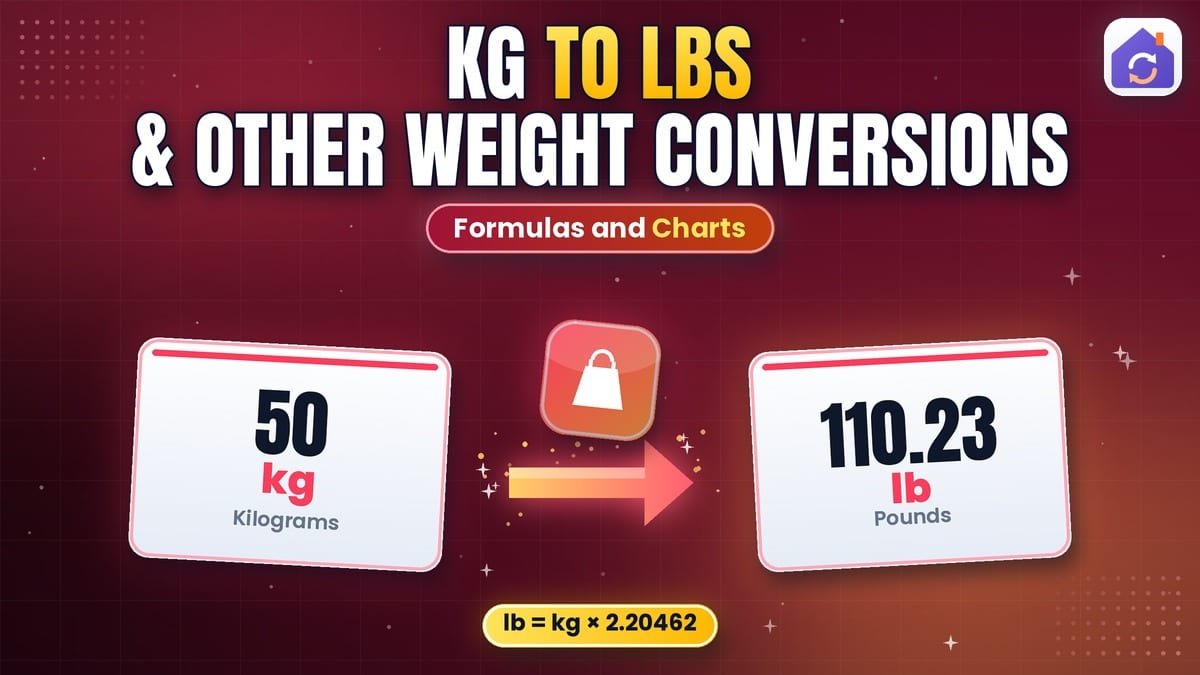
One kilogram equals 2.20462 pounds, and one pound equals exactly 0.45359237 kilograms — the pound has been defined that way since 1959.
- Kg to lbs: multiply by 2.20462.
- Lbs to kg: multiply by 0.453592 (or divide by 2.20462).
Quick mental method for kg to lbs: double the kilograms and add 10%. For 70 kg: 140 + 14 = 154 lbs (the exact answer is 154.3).
Common Weight Conversion Factors
| From | To | Multiply by |
|---|---|---|
| Kilograms | Pounds | 2.204623 |
| Pounds | Kilograms | 0.4535924 |
| Ounces | Grams | 28.34952 |
| Grams | Ounces | 0.03527396 |
| Stone (UK) | Kilograms | 6.350293 |
| Metric ton | Pounds | 2,204.623 |
| Carats | Grams | 0.2 (exact) |
Kg to Lbs Chart
| Kilograms | Pounds |
|---|---|
| 1 kg | 2.20 lbs |
| 5 kg | 11.02 lbs |
| 10 kg | 22.05 lbs |
| 20 kg | 44.09 lbs |
| 23 kg (common checked-bag limit) | 50.71 lbs |
| 50 kg | 110.23 lbs |
| 70 kg | 154.32 lbs |
| 100 kg | 220.46 lbs |
For single values, the quick pages are handy: kg to lbs and lbs to kg.
Ounces to Grams (and Back) for Cooking
Multiply ounces by 28.35 to get grams; divide grams by 28.35 for ounces. 8 oz of cheese is about 227 g, and a 500 g bag of pasta is about 17.6 oz. Remember that recipe “ounces” of weight are different from fluid ounces of volume — 1 cup of flour and 1 cup of water weigh very different amounts. See ounces to grams and grams to ounces.
Stone to Kg and Pounds
In the UK and Ireland, body weight is often given in stone and pounds. One stone is exactly 14 pounds, or 6.35 kg. To convert 11 st 4 lb: (11 × 14 + 4) = 158 lbs, × 0.4536 = 71.7 kg. Our stone to kg page does it instantly.
Weight vs Mass: What’s the Difference?
In everyday life, “weight” and “mass” are used interchangeably, but scientists distinguish them:
- Mass is the amount of matter in an object, measured in kilograms. It’s the same on Earth and on the Moon.
- Weight is the force of gravity on that mass, measured in newtons. On the Moon, you weigh about one sixth of your Earth weight, but your mass doesn’t change.
To turn mass into weight (force): weight = mass × gravity. A 10 kg mass on Earth weighs 10 × 9.81 = 98.1 newtons. For force units, use the Force Converter. When a scale says “70 kg”, it’s really reporting mass.
How to Use the Weight and Mass Converter
With our free Weight and Mass Converter:
- Choose the unit you have and the unit you want.
- Type the value — the result updates as you type, in either direction.
- Swap units with one click, set significant digits and copy the result.
- Check the table for every other unit at once.
It includes 69 units: metric, imperial, short and long tons, troy ounces for precious metals, carats for gemstones, apothecary units and atomic mass units.
Short Tons, Long Tons and Metric Tonnes
| Ton | Pounds | Kilograms | Used in |
|---|---|---|---|
| Metric ton (tonne) | 2,204.6 | 1,000 | Most of the world |
| Short ton (US) | 2,000 | 907.2 | United States |
| Long ton (UK) | 2,240 | 1,016 | UK (traditional), shipping |
Kg to Lbs for Fitness and Travel
Gym plates and dumbbells are sold in both kilograms and pounds, and the numbers don’t line up neatly. A 20 kg Olympic bar is about 44 lbs, and a 45 lb plate is about 20.4 kg — close, but not identical, which matters when you’re tracking progress across gyms. Airlines are similar: a 23 kg checked bag limit is 50.7 lbs, while a 50 lb US limit is 22.7 kg. When in doubt, convert precisely rather than assuming a round figure, because being 0.5 kg over can cost a fee.
Weighing Babies and Pets
Baby weights are often given in pounds and ounces. To convert 7 lb 8 oz to kilograms, turn it into pounds first (8 oz = 0.5 lb, so 7.5 lb) and multiply by 0.4536 to get 3.40 kg. Vets and pet food labels commonly use kilograms, so the same conversion helps with feeding guides and medication doses.
Troy Ounces for Gold and Silver
Precious metals use troy ounces: 1 troy ounce = 31.1035 grams, about 10% heavier than a regular ounce. Gold prices quoted “per ounce” always mean troy ounces.
Common Mistakes
- Mixing fluid ounces (volume) with ounces (weight).
- Assuming “ton” means the same thing in every country.
- Rounding 2.2 too early in large calculations — use 2.20462 for accuracy.
For the official definition of the kilogram, see the kilogram article on Wikipedia.
Final Thoughts
To convert kg to lbs, multiply by 2.20462; for lbs to kg, multiply by 0.453592. Use 28.35 for ounces to grams and 6.35 for stone to kg, and remember that weight in science means force. Try the free Weight and Mass Converter for 69 units in one place.
Frequently Asked Questions
How do you convert kg to lbs?
Multiply the number of kilograms by 2.20462. For example, 50 kg × 2.20462 = 110.23 lbs, and 70 kg × 2.20462 = 154.32 lbs. The factor comes from the exact definition of the pound as 0.45359237 kg, so dividing by 0.45359237 gives the same answer. For body weight or luggage, rounding to one decimal place is plenty; for science or shipping invoices, keep more decimals until the final step.
How many lbs are in a kg?
One kilogram equals about 2.20462 pounds, or 2 pounds 3.27 ounces. The precise value is 2.2046226218 pounds, the reciprocal of the pound’s exact definition of 0.45359237 kg. In daily life, 2.2 is accurate enough: 10 kg is about 22 lbs and 100 kg is about 220 lbs. For more accurate results, use 2.2046 or our converter.
How do you convert pounds to kilograms?
Multiply the number of pounds by 0.453592. For example, 150 lbs × 0.453592 = 68.04 kg, and 200 lbs × 0.453592 = 90.72 kg. Dividing by 2.20462 gives the same result. A quick mental shortcut is to halve the pounds and subtract 10%: 150 halved is 75, minus 7.5 gives 67.5 kg, which is within 1% of the exact answer.
How many grams are in an ounce?
One avoirdupois ounce, the ounce used for food and everyday items, is about 28.35 grams (28.349523 g exactly). There are 16 ounces in a pound, so a pound is 453.59 grams. This is different from the fluid ounce, which measures volume, and from the troy ounce of 31.10 grams used for gold and silver. Check which ounce a recipe or label means before converting.
How do you convert ounces to grams?
Multiply the number of ounces by 28.35. For example, 4 oz × 28.35 = 113.4 grams, and 8 oz is about 226.8 grams. To go from grams to ounces, divide by 28.35 or multiply by 0.03527, so 100 grams is about 3.53 oz. In baking, grams are more accurate than ounces or cups, which is why many recipes give both.
How many kg is a stone?
One stone is exactly 14 pounds, which is about 6.35 kilograms (6.35029 kg). The stone is still widely used for body weight in the UK and Ireland. To convert, multiply stones by 6.35 and convert any extra pounds separately: 11 stone 4 lb is (11 × 14) + 4 = 158 lbs, which is about 71.7 kg. To go from kilograms to stones, divide by 6.35.
What is the difference between weight and mass?
Mass is the amount of matter in an object, measured in kilograms or pounds, and it is the same everywhere. Weight is the force gravity exerts on that mass, measured in newtons (or pound-force), and it changes with gravity. A 70 kg person has a weight of about 686 N on Earth but only about 113 N on the Moon. Everyday scales show mass because they are calibrated for Earth’s gravity.
How do you convert weight to mass?
Divide the weight (a force in newtons) by the gravitational acceleration where it was measured, which is about 9.81 m/s² on Earth. For example, a weight of 686.5 N ÷ 9.81 = 70 kg of mass. To go from mass to weight, multiply instead: 10 kg × 9.81 = 98.1 N. On the Moon you would use 1.62 m/s², which is why the same mass weighs about one sixth as much there.
What is a quick way to convert kg to lbs in my head?
Double the kilograms and then add 10% of that result. For 80 kg, doubling gives 160 and 10% of 160 is 16, so the answer is about 176 lbs, very close to the exact 176.37 lbs. The shortcut works because 2 × 1.1 = 2.2, which is close to the real factor of 2.20462. For pounds to kilograms, halve the number and subtract 10%.
Is a troy ounce the same as an ounce?
No. A troy ounce is about 31.10 grams, roughly 10% heavier than the standard avoirdupois ounce of 28.35 grams. Troy ounces are used only for precious metals such as gold, silver and platinum, so bullion prices are always quoted per troy ounce. A troy pound also has 12 troy ounces rather than 16, which makes it lighter than a regular pound despite the heavier ounce.