A weather forecast says 30 degrees — is that a heatwave or a cold snap? It depends on the scale. Most of the world uses Celsius, the United States uses Fahrenheit, and scientists use kelvin. Converting celsius to fahrenheit isn’t as simple as multiplying by one number, because the scales start at different points. Here’s how it works, with formulas you can actually remember.
The Three Main Temperature Scales
| Scale | Water freezes | Water boils | Used in |
|---|---|---|---|
| Celsius (°C) | 0 | 100 | Most countries, science |
| Fahrenheit (°F) | 32 | 212 | United States and a few territories |
| Kelvin (K) | 273.15 | 373.15 | Science and engineering |
Celsius and kelvin degrees are the same size; a Fahrenheit degree is smaller — 1 °C of change equals 1.8 °F of change.
Celsius to Fahrenheit Formula
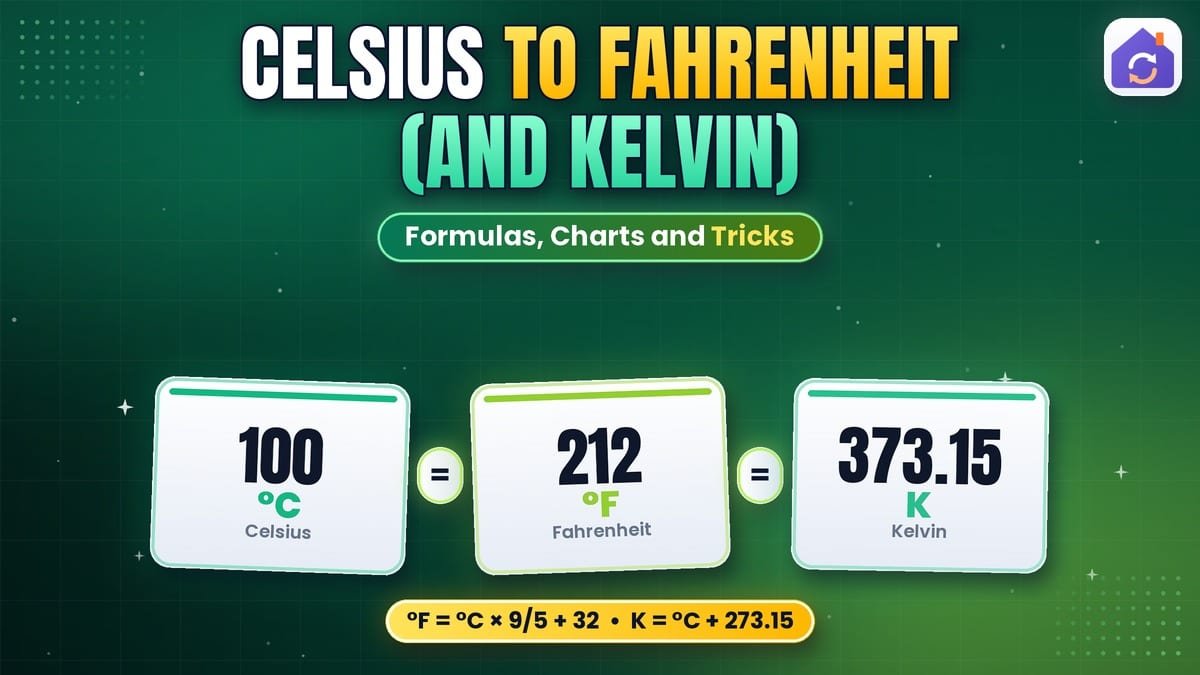
°F = (°C × 9/5) + 32, which is the same as °C × 1.8 + 32.
Example: 25 °C × 1.8 = 45, + 32 = 77 °F.
Fahrenheit to Celsius Formula
°C = (°F − 32) × 5/9.
Example: 98.6 °F − 32 = 66.6, × 5/9 = 37 °C — normal body temperature.
Notice the order: for Fahrenheit to Celsius, subtract 32 first, then multiply. Doing it the other way round is the most common mistake.
Celsius to Kelvin and Back
K = °C + 273.15 and °C = K − 273.15. No multiplication needed, because the degrees are the same size. 20 °C is 293.15 K. Kelvin has no negative values — 0 K, absolute zero, is the coldest possible temperature (−273.15 °C or −459.67 °F).
Quick Celsius to Fahrenheit Chart
| °C | °F | What it feels like |
|---|---|---|
| −40 | −40 | The point where both scales meet |
| −10 | 14 | Bitterly cold |
| 0 | 32 | Water freezes |
| 10 | 50 | Cool |
| 20 | 68 | Room temperature |
| 25 | 77 | Warm |
| 30 | 86 | Hot |
| 37 | 98.6 | Body temperature |
| 40 | 104 | Heatwave |
| 100 | 212 | Water boils (sea level) |
| 180 | 356 | Moderate oven |
| 200 | 392 | Hot oven |
Mental Shortcuts
- Celsius to Fahrenheit: double it and add 30. 20 °C → 40 + 30 = 70 °F (exact: 68). Good within a few degrees for weather.
- Fahrenheit to Celsius: subtract 30 and halve. 80 °F → 50 ÷ 2 = 25 °C (exact: 26.7).
- Memorable pairs: 16 °C ≈ 61 °F and 28 °C ≈ 82 °F — the digits swap.
Is Celsius to Fahrenheit Linear?
Yes — the relationship is a straight line, but with an offset. That’s why you can’t just multiply by a single number: you need both the 1.8 scale factor and the 32-degree offset. It also means a temperature difference converts differently from a temperature reading: a rise of 10 °C is a rise of 18 °F, not 50 °F. For differences, use the Temperature Interval Converter.
How to Use the Temperature Converter
Our free Temperature Converter handles Celsius, Fahrenheit, kelvin, Rankine and Réaumur:
- Choose the scale you have and the one you want.
- Type the temperature — negative values work too.
- See the result instantly, along with the exact formula used.
- Swap direction or copy the result with one click.
Popular single conversions have their own pages: Celsius to Fahrenheit, Fahrenheit to Celsius and Celsius to Kelvin.
Fever and Body Temperature
Thermometers in some countries show Celsius, others Fahrenheit. Normal body temperature is around 37 °C (98.6 °F), though healthy readings vary a little from person to person. A fever usually starts at about 38 °C, which is 100.4 °F. A high fever of 39.5 °C is 103.1 °F. Always follow medical advice for your situation — these figures are just conversions, not guidance.
Weather Around the World
Travelling between Celsius and Fahrenheit countries is where conversions matter most. A pleasant spring day of 18 °C is 64 °F; a hot summer afternoon of 35 °C is 95 °F; and a cold winter morning of −5 °C is 23 °F. Many phones and weather apps let you switch units, but knowing a few reference points helps you understand forecasts instantly.
Oven Temperatures
Recipes often list oven temperatures in one scale only. Common settings: 150 °C ≈ 300 °F, 160 °C ≈ 320 °F, 180 °C ≈ 350 °F, 200 °C ≈ 400 °F, 220 °C ≈ 425 °F. Recipes usually round to the nearest 25 °F. For fan ovens, recipes typically reduce the temperature by about 20 °C.
Why Does the US Still Use Fahrenheit?
Fahrenheit was the standard in Britain and its colonies for centuries. Most countries switched to Celsius during metrication in the 1960s and 70s, but the United States never completed the change. Fans of Fahrenheit point out that its smaller degrees give finer weather readings without decimals; Celsius fans prefer its simple link to water and the metric system.
Common Mistakes
- Multiplying before subtracting 32 when converting Fahrenheit to Celsius.
- Writing “degrees kelvin” — it’s simply “kelvin” (K), without the degree sign.
- Converting temperature differences with the offset formula.
For the history of the scales, see Celsius on Wikipedia.
Final Thoughts
To convert celsius to fahrenheit, multiply by 1.8 and add 32; to go back, subtract 32 and multiply by 5/9. Add 273.15 for kelvin. Use the “double and add 30” trick for weather, and exact formulas for cooking and science. Try the free Temperature Converter for instant, exact results.
Frequently Asked Questions
How do you convert Celsius to Fahrenheit?
Multiply the Celsius temperature by 1.8 (or 9/5) and then add 32. For example, 30 °C × 1.8 = 54, and 54 + 32 = 86 °F. Room temperature of 20 °C works out to 68 °F, and boiling water at 100 °C is 212 °F. The order matters: always multiply first and add 32 afterwards, otherwise the result will be wrong.
What is the Fahrenheit to Celsius formula?
The formula is °C = (°F − 32) × 5/9. Subtract 32 first, then multiply by 5/9 (or divide by 1.8). For example, 98.6 °F − 32 = 66.6, and 66.6 × 5/9 = 37 °C. Likewise 50 °F becomes (50 − 32) × 5/9 = 10 °C. Doing the subtraction before the multiplication is essential, because the 32-degree offset belongs to the Fahrenheit scale.
How do you convert Celsius to Kelvin?
Add 273.15 to the Celsius temperature. For example, 25 °C + 273.15 = 298.15 K, and 0 °C equals 273.15 K. The two scales use the same size of degree, so only the starting point differs: kelvin starts at absolute zero. To go back, subtract 273.15. Note that kelvin is written without a degree sign, so you write 300 K, not 300 °K.
What is 37 °C in Fahrenheit?
Thirty-seven degrees Celsius is 98.6 °F: 37 × 1.8 = 66.6, and 66.6 + 32 = 98.6. This is the traditional value for normal human body temperature, although modern studies show healthy readings usually range from about 36.1 °C to 37.2 °C (97 °F to 99 °F). A temperature of 38 °C, or 100.4 °F, is commonly used as the threshold for a fever.
At what temperature are Celsius and Fahrenheit equal?
The two scales show the same number at −40 degrees, so −40 °C is exactly −40 °F. You can prove it by setting F = C in the formula F = 1.8C + 32, which gives C = 1.8C + 32, and solving gives C = −40. At every other temperature the numbers differ. This coincidence only applies to actual readings, not to temperature changes.
How many Fahrenheit degrees are in one Celsius degree?
A change of 1 °C is equal to a change of 1.8 °F, because the Fahrenheit scale divides the range between freezing and boiling water into 180 degrees instead of 100. When converting a temperature difference, such as “5 °C warmer”, multiply by 1.8 but do not add 32: a 5 °C rise is a 9 °F rise. Adding 32 is only for converting actual readings.
Is Celsius to Fahrenheit linear?
Yes. The relationship is a straight line, F = 1.8C + 32, but it is not a simple proportion because of the 32-degree offset. That means you cannot convert by multiplication alone, and doubling a Celsius temperature does not double the Fahrenheit value: 10 °C is 50 °F, while 20 °C is 68 °F. Only kelvin and Rankine, which start at absolute zero, behave proportionally.
What is 180 °C in Fahrenheit for baking?
One hundred eighty degrees Celsius is 356 °F (180 × 1.8 + 32). Recipes usually round this to 350 °F, which is the standard “moderate oven” setting in the US. Other common conversions are 160 °C to 320 °F (often 325 °F), 200 °C to 392 °F (often 400 °F) and 220 °C to 428 °F (often 425 °F). For fan ovens, recipes often suggest lowering the temperature by about 20 °C.
Why is Celsius better than Fahrenheit?
Neither is objectively better, but they suit different needs. Celsius ties neatly to water, freezing at 0 and boiling at 100 at sea level, and fits the metric system, which is why science and most countries use it. Fahrenheit has smaller degrees, so whole numbers give finer weather readings, and 0 to 100 °F roughly spans typical outdoor temperatures in temperate climates. The US still uses Fahrenheit for daily life.
What is absolute zero?
Absolute zero is the lowest possible temperature, at which particles have the minimum possible energy. It is defined as 0 kelvin, which equals −273.15 °C and −459.67 °F. Nothing can be cooled to exactly absolute zero, but laboratories have reached temperatures within a billionth of a kelvin of it. The kelvin and Rankine scales both start at absolute zero, which is why they never use negative numbers.