Fuel prices per gallon, milk cartons in liters, recipes in cups, medicine in milliliters — volume units come from everywhere, and the same name doesn’t always mean the same amount. Converting liters to gallons is a perfect example: a US gallon and a UK gallon differ by about 20%. This guide sorts out the confusion with exact numbers, quick charts and practical tips for cooking, fuel and DIY.
Liters to Gallons: US vs UK
| Gallon | Liters | Used in |
|---|---|---|
| US gallon | 3.785412 | United States, some Latin American countries |
| Imperial (UK) gallon | 4.54609 | UK (traditionally), Canada (older usage) |
- Liters to US gallons: multiply by 0.264172.
- US gallons to liters: multiply by 3.785412.
- Liters to UK gallons: multiply by 0.219969.
- UK gallons to liters: multiply by 4.54609.
Example: a 60-liter car fuel tank holds 60 × 0.264172 = 15.85 US gallons, or 13.2 UK gallons.
Why Are There Two Gallons?
Historically, Britain used several gallons for wine, ale and corn. The US adopted the old wine gallon (231 cubic inches), while Britain standardised the larger imperial gallon in 1824, based on the volume of 10 pounds of water. Both survived, which is why fuel economy in miles per gallon also differs between the US and UK.
Liters to Gallons Chart (US)
| Liters | US gallons |
|---|---|
| 1 L | 0.26 |
| 2 L (soda bottle) | 0.53 |
| 4 L | 1.06 |
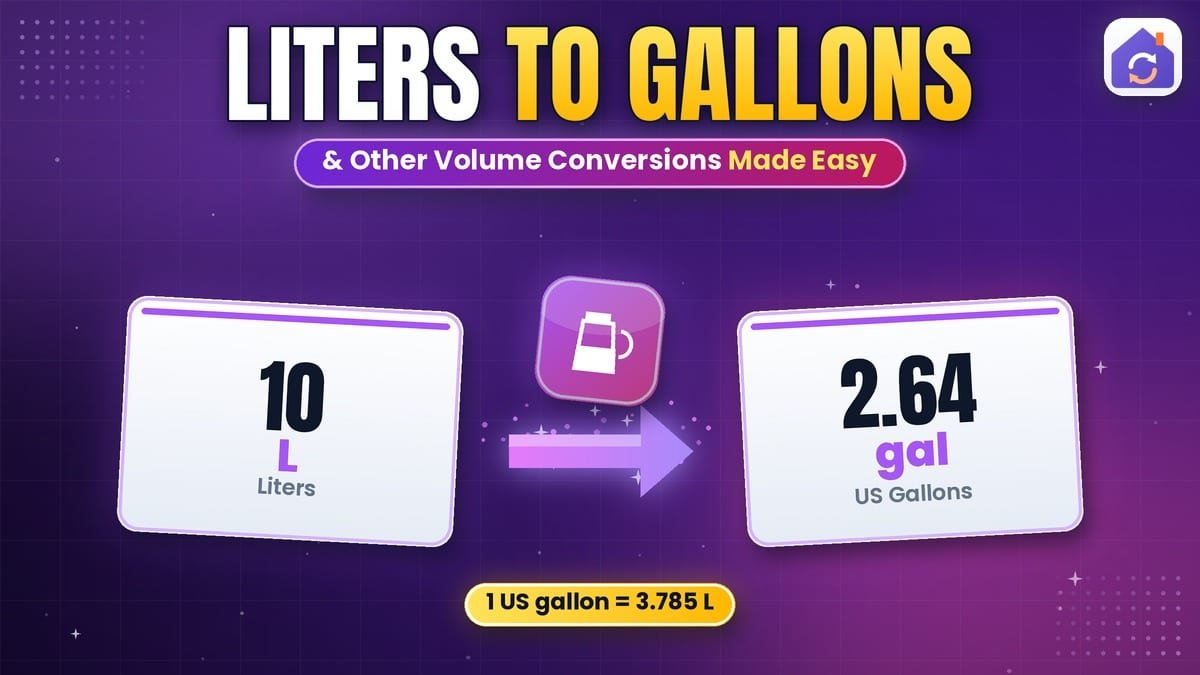
| 10 L | 2.64 |
| 20 L | 5.28 |
| 50 L | 13.21 |
| 100 L | 26.42 |
Need a single answer fast? Use liters to gallons or gallons to liters.
Kitchen Conversions: Cups, Spoons and Ounces
| US measure | Milliliters |
|---|---|
| 1 teaspoon | 4.93 |
| 1 tablespoon | 14.79 |
| 1 fluid ounce | 29.57 |
| 1 cup | 236.59 |
| 1 pint | 473.18 |
| 1 quart | 946.35 |
Metric recipes often use a rounded “metric cup” of 250 ml and a 15 ml tablespoon. UK pints are bigger than US pints: 568 ml versus 473 ml — worth knowing in a British pub. Quick lookups: cups to ml, ml to cups, oz to ml and tbsp to ml.
Volume vs Weight in Recipes
A cup measures volume, not weight. One cup of water weighs about 236 g, but a cup of flour is roughly 120–130 g and a cup of sugar about 200 g. Converting volume to weight needs the ingredient’s density, which is why serious bakers weigh ingredients. For weight units, see the Weight and Mass Converter.
Cubic Meters, Liters and Cubic Feet
- 1 cubic meter = 1,000 liters.
- 1 liter = 1,000 milliliters = 1,000 cubic centimeters (1 ml = 1 cc).
- 1 cubic foot = 28.32 liters.
- 1 cubic yard = 0.7646 cubic meters (useful for concrete and soil).
- 1 barrel of oil = 158.99 liters (42 US gallons).
To find the volume of a box or room, multiply length × width × height in the same unit, then convert the cubic result.
How to Use the Volume Converter
With our free Volume Converter:
- Select the unit you have and the unit you want — US and UK units are clearly labelled.
- Type a value in either box; the other updates instantly.
- Swap direction, choose significant digits and copy the result.
- Browse the full table to see the value in all 76 volume units.
Liters to Gallons for Fuel Prices
Comparing petrol or diesel prices between countries is a classic use of liters to gallons. If fuel costs 1.80 per liter, a US gallon costs 1.80 × 3.785 = 6.81, and a UK gallon 1.80 × 4.546 = 8.18 in the same currency. When reading fuel economy figures, check whether they use US or imperial gallons — a car rated at 40 mpg in the UK achieves about 33 mpg in US terms, because the US gallon is smaller.
Volume Conversion in Excel
Excel’s CONVERT function handles many volume units: =CONVERT(A1,"l","gal") gives US gallons and =CONVERT(A1,"l","uk_gal") gives imperial gallons. Unit codes are case-sensitive, so check Excel’s help for the exact abbreviations.
Where Volume Conversions Matter
- Fuel: comparing prices per liter and per gallon when travelling.
- Cooking: following recipes from other countries.
- Aquariums and pools: dosing treatments by volume.
- Medicine: doses in ml rather than teaspoons for accuracy.
- Shipping: container and cargo volumes in cubic meters or cubic feet.
Common Mistakes
- Using the US gallon when a UK source means imperial gallons (or vice versa).
- Confusing fluid ounces (volume) with ounces (weight).
- Assuming a “cup” is the same in every country — US, UK, metric and Japanese cups all differ.
For more on the history of the gallon, see the gallon article on Wikipedia.
Final Thoughts
To convert liters to gallons, multiply by 0.264 for US gallons or 0.220 for UK gallons — and always check which gallon your source means. In the kitchen, a US cup is 237 ml and a tablespoon 15 ml. Try the free Volume Converter for exact results in 76 units.
Frequently Asked Questions
How do you convert liters to gallons?
Multiply liters by 0.264172 to get US gallons, or by 0.219969 to get UK imperial gallons. For example, 20 liters is about 5.28 US gallons but only 4.40 UK gallons. Always check which gallon is meant: US sources such as fuel prices and recipes use the US gallon, while older UK documents use the imperial one. Dividing liters by 3.785 (US) or 4.546 (UK) gives the same results.
How many liters are in a gallon?
A US gallon holds about 3.785 liters (exactly 3.785411784 L), while a UK imperial gallon holds about 4.546 liters (exactly 4.54609 L). The imperial gallon is about 20% larger. So a 10-gallon fuel tank holds roughly 37.9 liters in the US but 45.5 liters in the UK. The US dry gallon, rarely used today, is about 4.40 liters.
How do you convert gallons to liters?
Multiply US gallons by 3.785412 or UK imperial gallons by 4.54609. For example, 5 US gallons × 3.785 = 18.93 liters, and 5 UK gallons × 4.546 = 22.73 liters. For a quick estimate of US gallons, multiply by 4 and subtract about 5%. If you are converting fuel economy rather than plain volume, use a fuel consumption converter, because miles per gallon involves distance as well.
Why is a UK gallon bigger than a US gallon?
The two countries inherited different gallons. The United States kept the old English wine gallon, defined as 231 cubic inches, about 3.785 liters. In 1824 Britain replaced its various gallons with a new imperial gallon based on the volume of 10 pounds of water, about 4.546 liters. The difference carries through to smaller units, so a UK pint (568 ml) is also larger than a US pint (473 ml).
How many ml are in a cup?
A US customary cup holds about 236.6 ml, while a metric cup, used in Australia, New Zealand and Canada, is exactly 250 ml. The US “legal cup” on nutrition labels is 240 ml. These small differences add up in baking, so for accuracy it is best to weigh ingredients or to follow the cup standard of the country the recipe comes from. One US cup is also 8 US fluid ounces.
How many ml are in a tablespoon?
A US tablespoon is about 14.8 ml, which is usually rounded to 15 ml, and the UK and international metric tablespoon is exactly 15 ml. Australia is the exception, using a 20 ml tablespoon. A teaspoon is about 4.9 ml in the US and 5 ml in metric countries, and three teaspoons make one tablespoon. For medicines, always use the dosing spoon or syringe supplied.
How many liters are in a cubic meter?
There are exactly 1,000 liters in one cubic meter, because a liter is defined as one cubic decimeter (10 cm × 10 cm × 10 cm) and a cubic meter contains 10 × 10 × 10 of those. This is why water bills often use cubic meters: 1 m³ is 1,000 liters, or roughly 264 US gallons. One cubic meter of water also weighs about 1,000 kilograms, one metric tonne.
Is 1 ml the same as 1 cc?
Yes. One milliliter is exactly one cubic centimeter, written cc or cm³, because a milliliter is defined as one thousandth of a liter, and a liter is 1,000 cm³. Medicine and engine sizes often use cc: a 5 cc dose is 5 ml, and a 1,600 cc engine has a displacement of 1.6 liters. The two terms can be swapped freely in any calculation.
How do you convert volume to weight?
Multiply the volume by the density of the substance. For water, density is about 1 kg per liter, so 1 liter weighs about 1 kilogram and 1 ml weighs about 1 gram. Other liquids differ: cooking oil is about 0.92 kg/L, so 1 liter weighs about 920 grams, while honey is about 1.4 kg/L. For dry ingredients like flour, density varies with packing, which is why weighing is more reliable.
How many liters are in a barrel of oil?
One barrel of crude oil is exactly 42 US gallons, which is about 159 liters (158.987 L). The size dates back to 19th-century Pennsylvania, where 42 gallons became the standard for shipping oil. Oil prices and production figures worldwide are quoted per barrel, often shortened to bbl. Note that beer and other barrels use different sizes, so the 159-liter figure applies only to oil.