A good kitchen conversion chart saves you from guessing when a recipe uses cups and your measuring jug shows milliliters. This guide puts every common volume conversion in one place, from teaspoons to gallons, and explains the US, UK and metric differences that catch many cooks out.
The Kitchen Conversion Chart for Volume
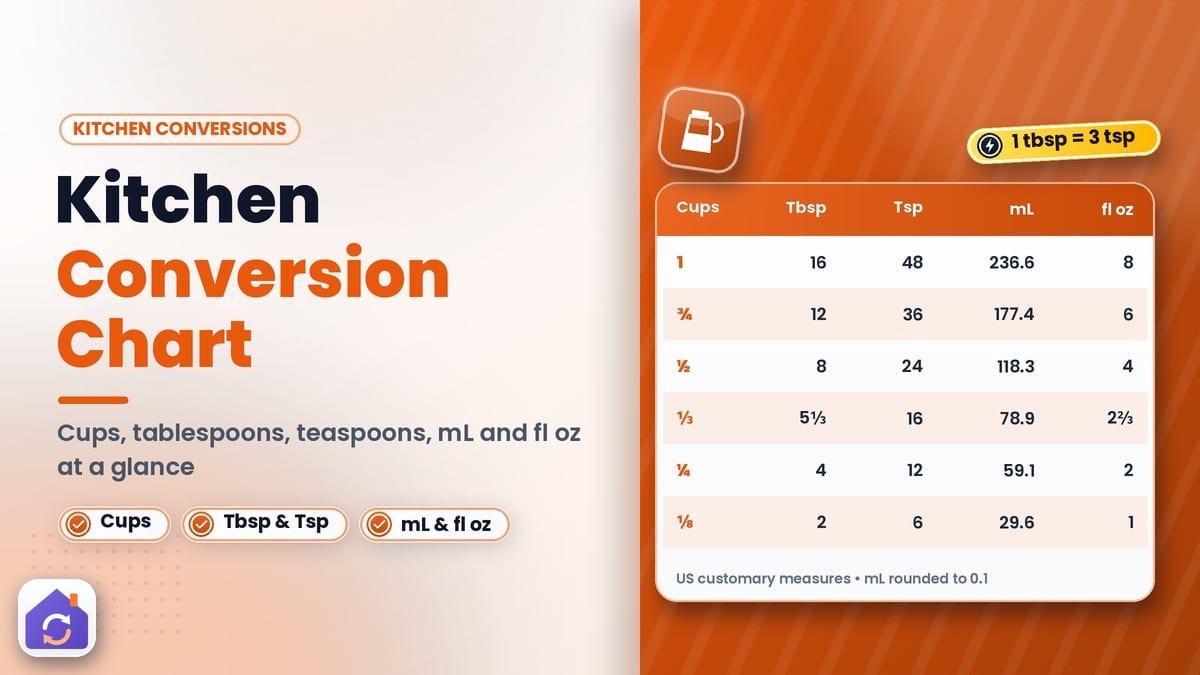
The table below uses US customary measures, the standard in American recipes. One US cup holds 236.6 ml, and every row is built from that figure.
| Cups | Tablespoons | Teaspoons | Fluid ounces | Milliliters |
|---|---|---|---|---|
| 1 cup | 16 tbsp | 48 tsp | 8 fl oz | 237 ml |
| ¾ cup | 12 tbsp | 36 tsp | 6 fl oz | 177 ml |
| ⅔ cup | 10 tbsp + 2 tsp | 32 tsp | 5.3 fl oz | 158 ml |
| ½ cup | 8 tbsp | 24 tsp | 4 fl oz | 118 ml |
| ⅓ cup | 5 tbsp + 1 tsp | 16 tsp | 2.7 fl oz | 79 ml |
| ¼ cup | 4 tbsp | 12 tsp | 2 fl oz | 59 ml |
| ⅛ cup | 2 tbsp | 6 tsp | 1 fl oz | 30 ml |
| — | 1 tbsp | 3 tsp | 0.5 fl oz | 15 ml |
| — | — | 1 tsp | 0.17 fl oz | 5 ml |
For any amount that is not in the chart, the cups to ml converter and the tablespoons to ml converter give exact answers as you type.
Larger Measures: Pints, Quarts and Gallons
Soups, stocks and batch cooking often use larger units. In the US system they double at each step, which makes them easy to remember.
- 1 pint = 2 cups = 16 fl oz = 473 ml
- 1 quart = 2 pints = 4 cups = 946 ml
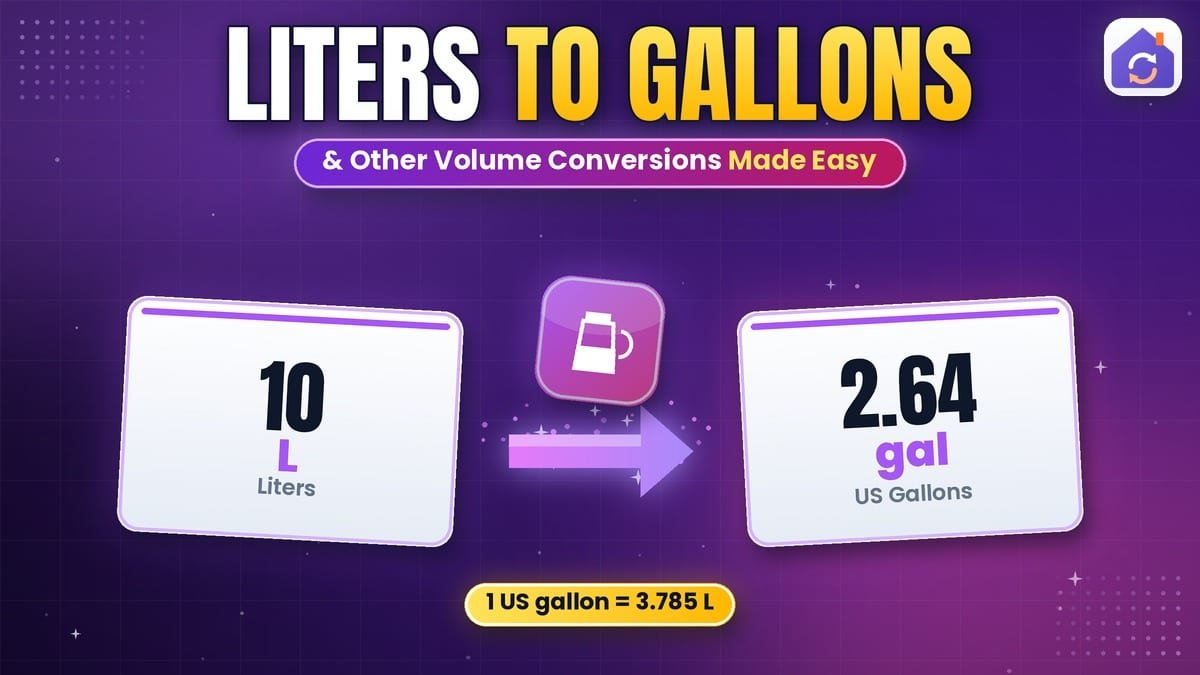
- 1 gallon = 4 quarts = 16 cups = 3.785 liters
A useful rule of thumb is that a quart is just under a liter, so a recipe calling for 1 quart of stock works fine with a 1-liter carton. For exact liter figures, use the quarts to liters converter.
US, UK and Metric Measures Are Not the Same
The biggest source of recipe mistakes is mixing systems. The names match, but the sizes do not:
| Measure | US | UK / imperial | Metric (AU, NZ, CA) |
|---|---|---|---|
| Cup | 236.6 ml | (rarely used) | 250 ml |
| Tablespoon | 14.8 ml | 15 ml | 15 ml (Australia: 20 ml) |
| Teaspoon | 4.93 ml | 5 ml | 5 ml |
| Fluid ounce | 29.6 ml | 28.4 ml | — |
| Pint | 473 ml | 568 ml | — |
Most of these differences are small enough to ignore for a single spoonful. They add up in large quantities: a UK pint is about 20% bigger than a US pint, and an Australian tablespoon holds a third more than an American one, which matters with salt, baking soda or spices.
How to Use a Kitchen Conversion Chart Accurately
The chart only works if you measure the same way the recipe writer did. A few habits make conversions reliable:
- Use the right tool. Liquid measuring jugs are for liquids; nested dry cups and spoons are for dry ingredients.
- Level dry measures. Spoon the ingredient in and scrape the top flat rather than packing it down.
- Read liquids at eye level. Looking down at a jug makes the level look higher than it is.
- Check where the recipe comes from. An Australian “1 tablespoon” is 20 ml, not 15 ml.
- Convert once. Rewrite the whole recipe in one unit system before you start cooking.
Volume vs Weight: When to Use a Scale
Cups and spoons measure volume, so a cup of flour and a cup of sugar take up the same space but weigh very different amounts. For baking, where ratios matter, weighing ingredients is far more consistent. A cup of all-purpose flour weighs about 120 g, while a cup of granulated sugar weighs about 198 g, so converting baking recipes to grams with the grams to ounces converter and a kitchen scale gives the most reliable results.
For liquids based on water, such as milk, stock or juice, volume and weight line up closely: 1 ml weighs about 1 gram. That makes the fluid ounces to ml converter just as useful as a scale for most drinks and sauces.
Quick Conversions Worth Memorising
- 3 teaspoons = 1 tablespoon
- 2 tablespoons = 1 fluid ounce ≈ 30 ml
- 4 tablespoons = ¼ cup
- 16 tablespoons = 1 cup
- 1 cup ≈ 240 ml for everyday cooking
- 1 stick of US butter = ½ cup = 8 tablespoons = 113 g
The official U.S. guidance on culinary measurement from NIST uses the same relationships, so you can rely on them for any American recipe.
Converting a Whole Recipe
When scaling or converting a full recipe, work line by line and write the new amounts down. Round sensibly: 158 ml of milk can be measured as 160 ml, but keep leavening agents and salt precise. If a converted amount lands between spoon sizes, such as 7 ml, combine measures, for example 1 teaspoon plus ½ teaspoon.
For anything unusual, the volume converter handles every cooking unit at once, including US and UK cups, pints, gallons and fluid ounces.
Frequently Asked Questions
How many tablespoons are in a cup?
There are 16 tablespoons in one US cup. That means half a cup is 8 tablespoons and a quarter cup is 4 tablespoons. If your recipe uses metric cups of 250 ml, one cup holds just under 17 metric tablespoons of 15 ml each, so the difference is small for most dishes.
How many teaspoons are in a tablespoon?
One tablespoon equals 3 teaspoons in the US, UK and metric systems. In milliliters, that is about 14.8 ml for a US tablespoon and exactly 15 ml for a metric one. Australia is the exception, where a tablespoon is 20 ml and therefore holds 4 metric teaspoons.
How many ml are in a cup?
A US customary cup holds 236.6 ml, often rounded to 240 ml on nutrition labels. A metric cup, used in Australia, New Zealand and Canada, is exactly 250 ml. For everyday cooking the difference rarely matters, but in baking it can change texture, so follow the cup standard of the recipe’s country.
How many fluid ounces are in a cup?
One US cup contains 8 US fluid ounces. Each fluid ounce is about 29.6 ml, so the cup works out to 236.6 ml. UK fluid ounces are slightly smaller at 28.4 ml, but UK recipes rarely use cups, so the US figure is the one you will need most often.
Is a UK tablespoon the same as a US tablespoon?
Almost. A UK tablespoon is exactly 15 ml, while a US tablespoon is about 14.8 ml, a difference of roughly 1%. You can use them interchangeably in practice. The tablespoon that really differs is the Australian one, which holds 20 ml, about a third more than either.
How many cups are in a quart?
There are 4 cups in a US quart, which is about 946 ml. A quart is also 2 pints or 32 fluid ounces. Because a quart is just under a liter, many cooks substitute a 1-liter carton of stock or milk for a quart in recipes without noticing any difference.
Why do my converted recipes turn out differently?
The most common causes are mixing US and metric cups, measuring flour by scooping instead of spooning, and Australian tablespoons being 20 ml. Measuring dry ingredients by volume also varies from person to person. For baking, weighing ingredients in grams gives far more consistent results than any volume conversion.
How many ml is a stick of butter?
A US stick of butter is half a cup, which is 8 tablespoons or about 118 ml by volume. It weighs about 113 grams. Most butter wrappers are marked in tablespoons, so you can cut exactly the amount a recipe needs without converting.
What is the easiest way to convert cups to ml?
Multiply the number of US cups by 236.6, or use 240 for quick everyday cooking. For example, 1.5 cups is about 355 ml. A free cups-to-ml converter gives exact results instantly and also handles fractions like a third or two-thirds of a cup.
Should I measure ingredients by weight or volume?
Use weight for baking and volume for most cooking. Weighing in grams removes the variation in how people fill cups, which is why professional bakers rely on scales. For liquids such as water, milk and stock, volume is accurate enough, because one milliliter weighs about one gram.