Rent a car abroad and the speedometer suddenly reads in different numbers. Check the wind forecast for sailing and it’s in knots. Do physics homework and everything is in meters per second. Converting km/h to mph and between the other speed units is simple once you know a few exact factors — and a couple of mental shortcuts make it easy on the road.
Key Speed Conversion Factors
| From | To | Multiply by |
|---|---|---|
| km/h | mph | 0.621371 |
| mph | km/h | 1.609344 |
| m/s | km/h | 3.6 |
| km/h | m/s | 0.277778 (÷ 3.6) |
| m/s | mph | 2.236936 |
| knots | mph | 1.150779 |
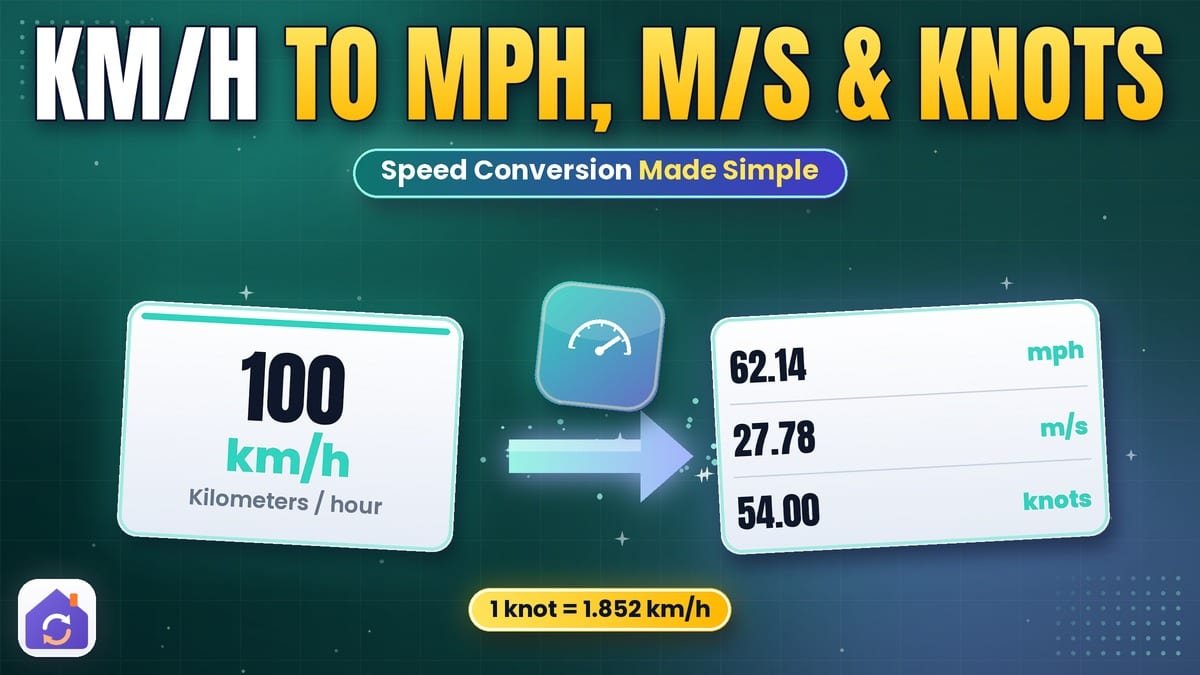
| knots | km/h | 1.852 (exact) |
| ft/s | mph | 0.681818 |
How to Convert Km/h to Mph
Multiply km/h by 0.6214. A 100 km/h motorway limit is 100 × 0.6214 = 62.1 mph. Mental trick: multiply by 6 and drop a zero — 80 km/h × 6 = 480 → 48 mph (exact: 49.7).
For mph to km/h, multiply by 1.6093: 70 mph = 112.7 km/h. Shortcut: add 60%. Quick pages: km/h to mph and mph to km/h.
Km/h to Mph Chart
| km/h | mph | Typical use |
|---|---|---|
| 30 | 18.6 | Urban zones in many countries |
| 50 | 31.1 | Town speed limit |
| 80 | 49.7 | Rural roads |
| 100 | 62.1 | Highways |
| 120 | 74.6 | Motorways |
| 130 | 80.8 | European motorways |
M/s to Km/h (and Back)
Meters per second is the SI unit of speed, used in physics and engineering. Multiply m/s by 3.6 to get km/h: 10 m/s = 36 km/h. Divide km/h by 3.6 for m/s: 90 km/h = 25 m/s. Why 3.6? There are 3,600 seconds in an hour and 1,000 meters in a kilometer, and 3,600 ÷ 1,000 = 3.6. See m/s to km/h.
Knots for Sea and Air
A knot is one nautical mile per hour, and a nautical mile is exactly 1,852 meters. So 1 knot = 1.852 km/h = 1.151 mph. Ships, aircraft and wind forecasts use knots because nautical miles relate directly to latitude: one nautical mile is about one minute of arc on Earth’s surface. A 20-knot wind is 23 mph or 37 km/h. Quick page: knots to mph.
Speed vs Velocity
Speed is how fast something moves; velocity is speed in a particular direction. A car driving round a roundabout at a steady 30 km/h has constant speed but changing velocity. The units are the same, so converting speed units also converts velocity magnitudes. For how quickly speed changes, see the Acceleration Converter.
Running Pace and Speed
Runners often think in pace (minutes per kilometer or mile) rather than speed. To convert pace to speed, divide 60 by the pace in minutes: a 5:00 min/km pace is 60 ÷ 5 = 12 km/h, or 7.46 mph. A 10-minute mile is 6 mph, or 9.66 km/h.
How Fast Is Mach 1?
Mach 1 is the speed of sound, which depends on air temperature. At 20 °C at sea level it’s about 343 m/s, or 1,235 km/h (767 mph). High in the stratosphere, where it’s much colder, it drops to about 1,062 km/h. Our converter includes both the 20 °C value and the standard high-altitude value.
How to Use the Speed Converter
With our free Speed Converter:
- Choose the units — km/h, mph, m/s, knots, ft/s, Mach and more.
- Type a value in either box; the other updates instantly.
- Swap direction, set significant digits and copy the result.
- See the same speed in all 32 units in the table.
Speed Limits When Driving Abroad
Most countries post speed limits in km/h; the US and UK use mph. Many cars can switch their display between the two, and most speedometers show both scales. Before a road trip, learn the usual limits in the local unit: in much of Europe, 50 km/h in towns (31 mph), 90 km/h on country roads (56 mph) and 120–130 km/h on motorways (75–81 mph). Converting km/h to mph in your head with the “×6, drop a zero” trick keeps you safely within the limit.
Common Mistakes
- Using the length factor backwards — remember mph numbers are smaller than km/h numbers.
- Confusing knots with mph — knots are about 15% faster.
- Forgetting that the speed of sound varies with temperature.
For background on units of speed, see speed on Wikipedia.
Final Thoughts
To convert km/h to mph, multiply by 0.6214; for mph to km/h, multiply by 1.6093. Use 3.6 between m/s and km/h, and 1.852 between knots and km/h. Try the free Speed Converter for instant results in 32 units.
Frequently Asked Questions
How do you convert km/h to mph?
Multiply the speed in km/h by 0.621371. For example, 100 km/h × 0.621371 = 62.1 mph, and 50 km/h is about 31.1 mph. The factor is how many miles fit into one kilometer. For a quick estimate, multiply by 6 and divide by 10, so 120 km/h is about 72 mph (exactly 74.6). This is handy when driving abroad with a speedometer in a different unit.
How do you convert mph to km/h?
Multiply the speed in mph by 1.609344, which is the exact number of kilometers in a mile. For example, 60 mph × 1.609344 = 96.6 km/h, and 70 mph is about 112.7 km/h. A quick mental shortcut is to multiply by 1.6, or to add 60% to the mph value. So a 30 mph limit is about 48 km/h, close to the 50 km/h limit common in Europe.
How do you convert m/s to km/h?
Multiply meters per second by 3.6. One m/s means 3,600 meters in an hour, which is 3.6 kilometers, so the factor is exactly 3.6. For example, 20 m/s × 3.6 = 72 km/h, and a wind speed of 10 m/s is 36 km/h. To get mph from m/s instead, multiply by 2.23694, so 20 m/s is about 44.7 mph.
How do you go from km/h to m/s?
Divide the speed in km/h by 3.6. For example, 72 km/h ÷ 3.6 = 20 m/s, and 100 km/h ÷ 3.6 = 27.8 m/s. Physics problems usually need speeds in m/s, so this is one of the most common conversions in school. The logic is that 1 km/h means 1,000 meters in 3,600 seconds, which simplifies to 1 ÷ 3.6 meters per second.
How many mph is a knot?
One knot is exactly 1.852 km/h, which is about 1.151 mph or 0.514 m/s. A knot means one nautical mile per hour, and the nautical mile is defined as exactly 1,852 meters. So a ship sailing at 20 knots is doing about 23 mph or 37 km/h, and an airliner cruising at 480 knots is moving at about 552 mph or 889 km/h.
What is the difference between speed and velocity?
Speed tells you how fast something is moving, while velocity tells you how fast and in which direction. Speed is a scalar, just a number with units such as 60 km/h. Velocity is a vector, such as 60 km/h heading north. A car driving around a roundabout at a steady 30 km/h has a constant speed, but its velocity keeps changing because its direction does.
How do you convert km to miles easily?
Multiply the kilometers by 6 and divide by 10, which is the same as multiplying by 0.6. This gives a result within about 3.5% of the exact factor of 0.621371. For example, 50 km becomes 30 miles (exactly 31.07), and 160 km becomes 96 miles (exactly 99.4). Another trick uses Fibonacci numbers: 5 miles is about 8 km, 8 miles is about 13 km, and 13 miles is about 21 km.
How fast is the speed of sound?
In dry air at 20 °C and sea level, sound travels at about 343 m/s, which is roughly 1,235 km/h or 767 mph. The speed depends mainly on temperature: it falls to about 331 m/s at 0 °C and is lower still at the cold altitudes where jets fly, around 295 m/s. Sound travels much faster in water, about 1,480 m/s, and faster again in steel.
How do I convert running pace to speed?
Divide 60 by your pace in minutes per unit of distance. A pace of 5 minutes per kilometer gives 60 ÷ 5 = 12 km/h, and a pace of 8 minutes per mile gives 60 ÷ 8 = 7.5 mph. For paces with seconds, convert to decimal minutes first, so 5:30 becomes 5.5 minutes and gives 10.9 km/h. To go from speed to pace, divide 60 by the speed.
Why do ships and planes use knots?
Knots are based on the nautical mile, which was originally defined as one minute of latitude on the Earth’s surface. That makes navigation simple: travelling 60 nautical miles north or south moves you one degree of latitude, so distances can be read straight from charts. Today the nautical mile is fixed at exactly 1,852 meters, and knots remain the standard speed unit in shipping and aviation worldwide.