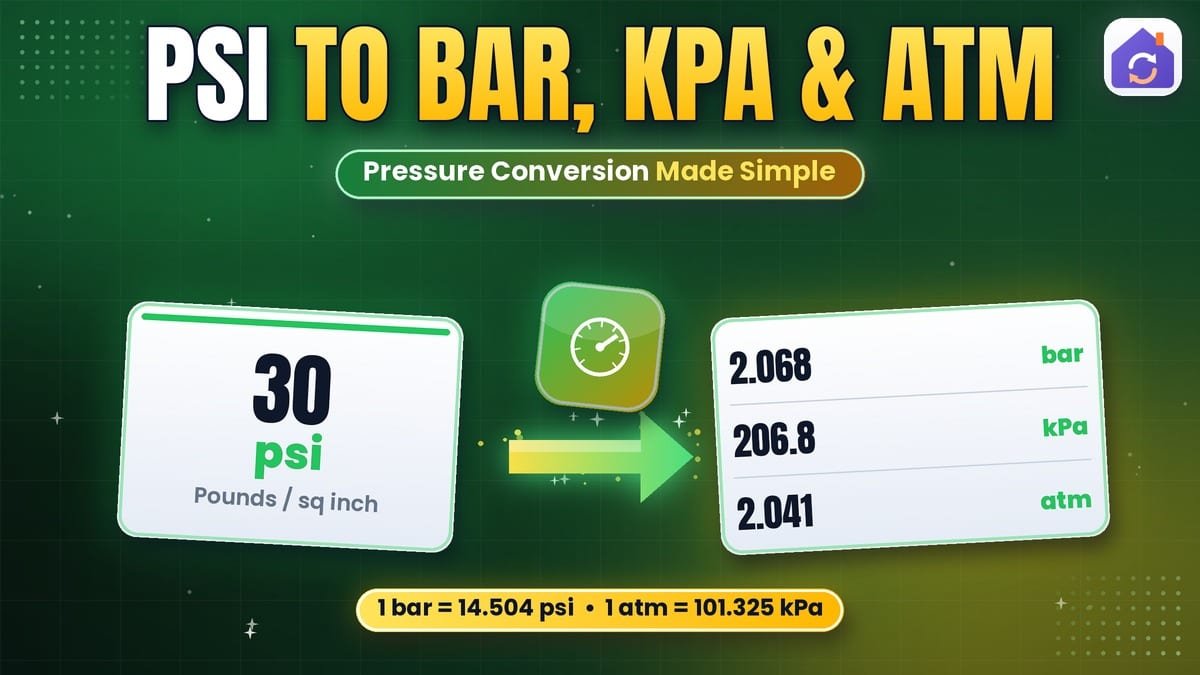
Pressure shows up in tyre gauges, weather forecasts, scuba tanks, pressure washers, hydraulic systems and medical equipment — each with its favourite unit. Americans think in psi, Europeans in bar, engineers in kilopascals and meteorologists in millibars. Converting psi to bar is the most common request, but this guide covers all the main units with exact factors.
What Is Pressure?
Pressure is force spread over an area. The SI unit is the pascal (Pa), one newton per square meter — a very small pressure, which is why kilopascals (kPa) and megapascals (MPa) are common. The psi is pounds-force per square inch. The bar is 100,000 Pa, very close to atmospheric pressure at sea level.
Key Pressure Conversion Factors
| From | To | Multiply by |
|---|---|---|
| psi | bar | 0.0689476 |
| bar | psi | 14.50377 |
| psi | kPa | 6.894757 |
| kPa | psi | 0.1450377 |
| bar | kPa | 100 (exact) |
| atm | kPa | 101.325 (exact) |
| atm | psi | 14.69595 |
| MPa | psi | 145.0377 |
| mmHg | kPa | 0.1333224 |
How to Convert PSI to Bar
Multiply psi by 0.0689 (or divide by 14.504). A car tyre at 32 psi is 32 × 0.0689476 = 2.21 bar. For bar to psi, multiply by 14.504: 2.5 bar = 36.3 psi. Mental shortcut: divide psi by 14.5 for bar, or multiply bar by 14.5 for psi. Quick pages: psi to bar and bar to psi.
Tyre Pressure Chart
| psi | bar | kPa |
|---|---|---|
| 26 | 1.79 | 179 |
| 30 | 2.07 | 207 |
| 32 | 2.21 | 221 |
| 35 | 2.41 | 241 |
| 40 | 2.76 | 276 |
| 60 | 4.14 | 414 |
| 100 (road bike) | 6.89 | 689 |
Always use the pressure from your vehicle’s door-jamb sticker or manual, measured with cold tyres.
PSI to kPa
Many car manuals and Canadian tyre stickers use kilopascals. Multiply psi by 6.895 for kPa; divide kPa by 6.895 for psi. 240 kPa ≈ 34.8 psi. See psi to kPa and kPa to psi.
Gauge Pressure vs Absolute Pressure
A tyre gauge reads gauge pressure — pressure above the surrounding air. Absolute pressure includes atmospheric pressure too. A tyre at 32 psi gauge is about 46.7 psi absolute at sea level (32 + 14.7). Engineers sometimes write psig and psia to make this clear. Unit conversion works the same either way, as long as you don’t mix the two.
Weather and Atmospheric Pressure
Standard atmospheric pressure at sea level is 1 atm = 101.325 kPa = 1,013.25 millibars (hPa) = 29.92 inches of mercury = 760 mmHg. Weather maps use millibars or hectopascals (identical units). High pressure, above about 1,020 mb, usually means settled weather; low pressure brings clouds and rain.
Blood Pressure (mmHg)
Blood pressure is measured in millimeters of mercury, a unit from the old mercury manometers. A reading of 120/80 mmHg equals about 16.0/10.7 kPa. Medical guidance always uses mmHg, so conversion is mostly of academic interest.
How to Use the Pressure Converter
With our free Pressure Converter:
- Choose your units — psi, bar, kPa, MPa, atm, mmHg, inHg, torr and many more.
- Type a value in either box; the other updates instantly.
- Swap direction, set significant digits and copy the result.
- Check the full table to see the pressure in all 52 units.
PSI to Bar for Pressure Washers and Compressors
Pressure washers and air compressors are often rated in both units, but sometimes only one appears on the box. A 2,000 psi pressure washer is about 138 bar; a 150 bar model is about 2,176 psi. Air tools typically need around 90 psi (6.2 bar). When comparing equipment from different countries, convert psi to bar first so you’re comparing like with like — and check whether figures are maximum or working pressures.
Scuba Tanks and Gas Cylinders
Scuba cylinders are filled to around 200–232 bar in Europe and 3,000 psi in the US — roughly the same pressure. Divers converting between the two need care, because air consumption and remaining gas are calculated from these numbers. A 200 bar fill is about 2,900 psi, and 3,000 psi is about 207 bar.
Where Pressure Conversions Matter
- Car, motorbike and bicycle tyres.
- Pressure washers, compressors and pneumatic tools.
- Scuba diving (bar on most tanks, psi in the US).
- Hydraulics and structural engineering (MPa and psi).
- Weather forecasting and aviation (hPa and inHg).
Altitude and Pressure
Air pressure falls as you climb: at about 1,500 m it’s roughly 84 kPa. That’s why sealed snack bags puff up on mountain roads and in aircraft cabins.
Common Mistakes
- Confusing gauge and absolute pressure.
- Mixing up kPa and MPa — a factor of 1,000.
- Treating bar and atm as identical — they’re close (1 atm = 1.01325 bar) but not equal.
For background, see pressure on Wikipedia, and for the force behind it, our Force Converter.
Final Thoughts
To convert psi to bar, multiply by 0.0689; for bar to psi, multiply by 14.5. Remember 1 bar = 100 kPa and 1 atm = 101.325 kPa, and keep gauge and absolute readings separate. Try the free Pressure Converter for instant results in 52 units.
Frequently Asked Questions
How do you convert psi to bar?
Multiply pounds per square inch by 0.0689476. For example, 32 psi × 0.0689476 = 2.21 bar, and 100 psi is about 6.89 bar. Dividing by 14.5038 gives the same result. This conversion comes up most often with tyre pressures, air compressors and pressure washers, where American equipment uses psi and European equipment uses bar.
How do you convert bar to psi?
Multiply bar by 14.5038. For example, 2.5 bar × 14.5038 = 36.3 psi, and 10 bar is about 145 psi. For a quick estimate, multiply by 14.5, or by 15 and subtract a little. Many European car manuals list tyre pressures in bar, so this conversion is useful when filling tyres with a psi gauge at a petrol station.
How many psi is 1 bar?
One bar is about 14.5038 psi. A bar is defined as exactly 100,000 pascals, while a psi is about 6,894.76 pascals, so dividing gives 14.5. One bar is also close to the air pressure at sea level, which is about 14.7 psi or 1.013 bar. That is why pressures in bar are easy to picture: 2 bar is roughly twice normal atmospheric pressure.
How do you convert psi to kPa?
Multiply psi by 6.894757. For example, 35 psi × 6.894757 = 241.3 kPa, and 30 psi is about 206.8 kPa. To go from kPa to psi, divide by 6.895 or multiply by 0.145. Canada, Australia and many car manufacturers print tyre pressures in kPa, so 220 kPa is about 31.9 psi or 2.2 bar.
How many kPa are in a bar?
There are exactly 100 kilopascals in one bar, because a bar is defined as 100,000 pascals. That makes converting between them very simple: 2.4 bar is 240 kPa, and 350 kPa is 3.5 bar. Weather maps often use hectopascals (hPa) instead, and since 1 hPa equals 1 millibar, standard sea-level pressure is about 1,013 hPa or 1,013 mbar.
What is 1 atm in psi?
One standard atmosphere is about 14.696 psi, which is exactly 101,325 pascals or 1.01325 bar. It represents the average air pressure at sea level. Scuba divers use it often: every 10 meters of seawater adds roughly another atmosphere, so at 10 m depth the total pressure is about 2 atm, or 29.4 psi absolute.
What is the difference between psig and psia?
psig (gauge) measures pressure above the surrounding atmosphere, which is what tyre gauges and compressor dials show, so an open tyre reads 0 psig. psia (absolute) includes atmospheric pressure, so the same open tyre is about 14.7 psia at sea level. To convert, add about 14.7 to psig to get psia. Engineering calculations involving gases usually need absolute pressure.
What is 32 psi in bar?
Thirty-two psi is about 2.21 bar (32 × 0.0689476 = 2.206). It is one of the most common car tyre pressures, and European tyre placards would usually round it to 2.2 bar. In kilopascals it is about 221 kPa. Always use the pressure printed on your vehicle’s door placard or manual rather than the maximum printed on the tyre sidewall.
Is a bar the same as an atmosphere?
Almost, but not exactly. One standard atmosphere is 1.01325 bar, so a bar is about 1.3% smaller. The bar is a round metric unit, exactly 100,000 pascals, while the atmosphere is based on average sea-level pressure. For everyday purposes they can be treated as nearly equal, but scientific and engineering calculations should use the precise factor of 1.01325.
What unit is used for blood pressure?
Blood pressure is measured in millimeters of mercury (mmHg), a unit from the original mercury column instruments. A normal reading such as 120/80 mmHg means 120 mmHg when the heart beats and 80 mmHg between beats. In SI units, 120 mmHg is about 16.0 kPa and 80 mmHg about 10.7 kPa. Like tyre pressure, it is a gauge pressure above atmospheric pressure.