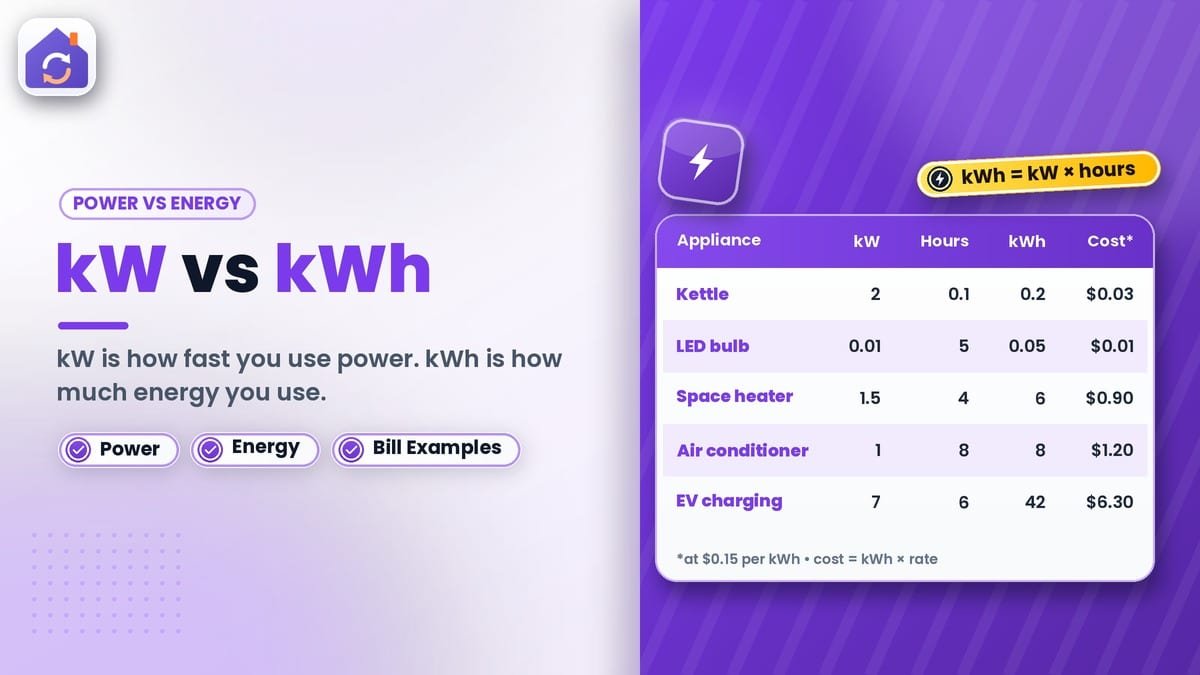
The difference in kW vs kWh is the difference between speed and distance. A kilowatt (kW) measures power, how fast electricity is being used at a moment. A kilowatt-hour (kWh) measures energy, how much electricity was used over time. Appliance labels show watts or kilowatts, while your electricity bill charges for kilowatt-hours.
kW vs kWh in One Sentence
kWh = kW × hours. A device drawing 1 kW for 1 hour uses 1 kWh. The same device running for 30 minutes uses 0.5 kWh, and running for 3 hours uses 3 kWh.
Because appliance ratings are usually in watts, convert them first: divide watts by 1,000 to get kilowatts. A 2,000 W heater is 2 kW, and a 600 W microwave is 0.6 kW. The watts to kW converter does this instantly.
Everyday Examples of kWh
| Appliance | Power | Time used | Energy used |
|---|---|---|---|
| LED bulb | 10 W (0.01 kW) | 5 hours | 0.05 kWh |
| Laptop | 60 W (0.06 kW) | 8 hours | 0.48 kWh |
| Kettle | 2,000 W (2 kW) | 3 minutes | 0.1 kWh |
| Microwave | 600 W (0.6 kW) | 10 minutes | 0.1 kWh |
| Space heater | 1,500 W (1.5 kW) | 4 hours | 6 kWh |
| Electric oven | 2,400 W (2.4 kW) | 1 hour | 2.4 kWh |
Notice that a powerful kettle can use less energy than a modest laptop, simply because it runs for a few minutes instead of a whole working day. Power alone does not tell you how much you will pay.
How Your Electricity Bill Uses kWh
Utilities charge per kilowatt-hour, often called a “unit”. To estimate the cost of running something, multiply its kWh by your price per kWh:
cost = kW × hours × price per kWh
Example: a 1.5 kW heater used for 4 hours a day uses 6 kWh. At 0.25 per kWh that is 1.50 a day, or about 45 a month. Your bill shows the total kWh used in the billing period and the rate charged for each one.
Average household use varies widely by country and climate. In the United States, a typical home uses roughly 10,500 to 10,800 kWh a year according to the U.S. Energy Information Administration, about 900 kWh a month, while European homes often use far less.
Why kW Still Matters
Kilowatts tell you how much power can be drawn at once, which matters for wiring, fuses and generators. A 13 A UK socket supplies about 3 kW, and a typical US 15 A circuit about 1.8 kW, so plugging several high-power appliances into one circuit can trip the breaker even if the total energy used is small.
Some business and solar tariffs also charge for peak demand in kW, separately from energy in kWh. That is why factories try to avoid switching on every machine at the same moment.
kW vs kWh for Solar Panels and Batteries
- Solar panels are rated in kW of peak power. A 4 kW system produces about 4 kWh in an hour of full sun.
- Daily solar output is in kWh: with about 4 peak sun hours, a 4 kW system makes roughly 16 kWh a day before losses.
- Home batteries list both: capacity in kWh (how much they store) and power in kW (how fast they can deliver it). A 10 kWh battery with a 5 kW rating can run a 5 kW load for about 2 hours.
kW vs kWh for Electric Cars
Electric vehicles use the same two units. Battery size is in kWh, and charger speed is in kW. A 60 kWh battery on a 7 kW home charger takes about 60 ÷ 7 ≈ 8.6 hours to fill from empty, while a 150 kW rapid charger can add most of the charge in well under an hour. Efficiency is often quoted in kWh per 100 km or miles per kWh.
Common Mistakes
- Writing “kW per hour” — the correct energy unit is the kilowatt-hour (kWh), not kW/h.
- Comparing appliances by power alone, without considering how long they run.
- Forgetting to convert minutes to hours: 15 minutes is 0.25 hours.
For other energy units, such as BTU, joules or calories, the energy converter converts kWh into all of them, and the kWh to BTU converter helps compare gas and electric heating. More background is in the kilowatt-hour article on Wikipedia.
Frequently Asked Questions
What is the difference between kW and kWh?
A kilowatt (kW) measures power, the rate at which electricity is used at a given moment. A kilowatt-hour (kWh) measures energy, the total amount used over time. Running a 1 kW appliance for one hour uses 1 kWh. Appliance labels show power, while electricity bills charge for energy in kWh.
How do you convert kW to kWh?
Multiply the power in kilowatts by the number of hours it runs. A 2 kW heater running for 3 hours uses 2 × 3 = 6 kWh. If you know the power in watts, divide by 1,000 first. You cannot convert kW to kWh without knowing the running time.
How many kWh does a 1000 W appliance use?
A 1,000 W appliance is 1 kW, so it uses 1 kWh for every hour it runs. Running it for 30 minutes uses 0.5 kWh, and running it for 5 hours uses 5 kWh. Many appliances cycle on and off, such as fridges and heaters with thermostats, so actual use is often lower.
How do I calculate the cost of running an appliance?
Multiply the power in kW by the hours of use and by your electricity price per kWh. A 0.6 kW microwave used for 10 minutes a day uses 0.1 kWh, which costs 0.025 at 0.25 per kWh. Your price per kWh is printed on your electricity bill.
Is kWh the same as kW per hour?
No. A kilowatt-hour is kilowatts multiplied by hours, not divided. Writing kW per hour or kW/h is a common mistake. The correct unit for energy is the kWh, while kW per hour would describe how fast power changes, which is rarely needed outside power-grid engineering.
How many kWh does a house use per day?
It varies widely with climate, heating type and appliances. A typical US home uses roughly 10,500 to 10,800 kWh a year, which is about 29 kWh per day. Homes with electric heating or air conditioning use much more in peak seasons, while small apartments in mild climates may use under 10 kWh a day.
What does a 5 kW solar system produce?
A 5 kW solar system produces about 5 kWh in each hour of full, direct sun. Over a day, output depends on the number of peak sun hours: with 4 peak sun hours it makes around 20 kWh before losses. Panel angle, shading, temperature and season all affect the real figure.
What does kWh mean for an electric car?
For an electric car, kWh describes battery size, the amount of energy it can store. A 60 kWh battery holds enough energy to run a 60 kW load for one hour. Charging speed is given in kW, so a 7 kW charger adds about 7 kWh to the battery each hour.
Why does my circuit breaker trip if kWh use is low?
Breakers respond to power, not energy. If several appliances run at the same time, their combined kW can exceed what the circuit can supply, even though the total kWh over a day is small. Spreading high-power appliances such as heaters and kettles across different circuits prevents this.
How do I convert watts to kWh?
Divide watts by 1,000 to get kilowatts, then multiply by the hours of use. For example, a 60 W laptop used for 8 hours is 0.06 × 8 = 0.48 kWh. Use a watts-to-kW converter for the first step if you want to avoid arithmetic mistakes.